


How do you build trust?
Trust is at the foundation of all business. Elena Verna and I have said that we’re in the “trust-led growth” era, and I think that’s more obvious now than when we wrote it earlier this year. It’s one of the core principles of this newsletter.
But when it comes to building trust, I actually think we’ve skipped an important step: Even when I talk about this topic, I usually discuss the tactical level. Like, how to build trust through personality-driven distribution: founder-led content, employee-generated content, building in public, creator partnerships, etc.
But beneath that, I’ve realized there’s an even more fundamental fact:
Trust is built on truth.
If that sounds obvious, consider some of the implications.
True positioning
One of the reasons to do the painful work of actually positioning your product is that you can be honest with your customers.
Every founder and marketer and seller will naturally say, “We’re the best.” That’s such a given that we don’t even notice it anymore.
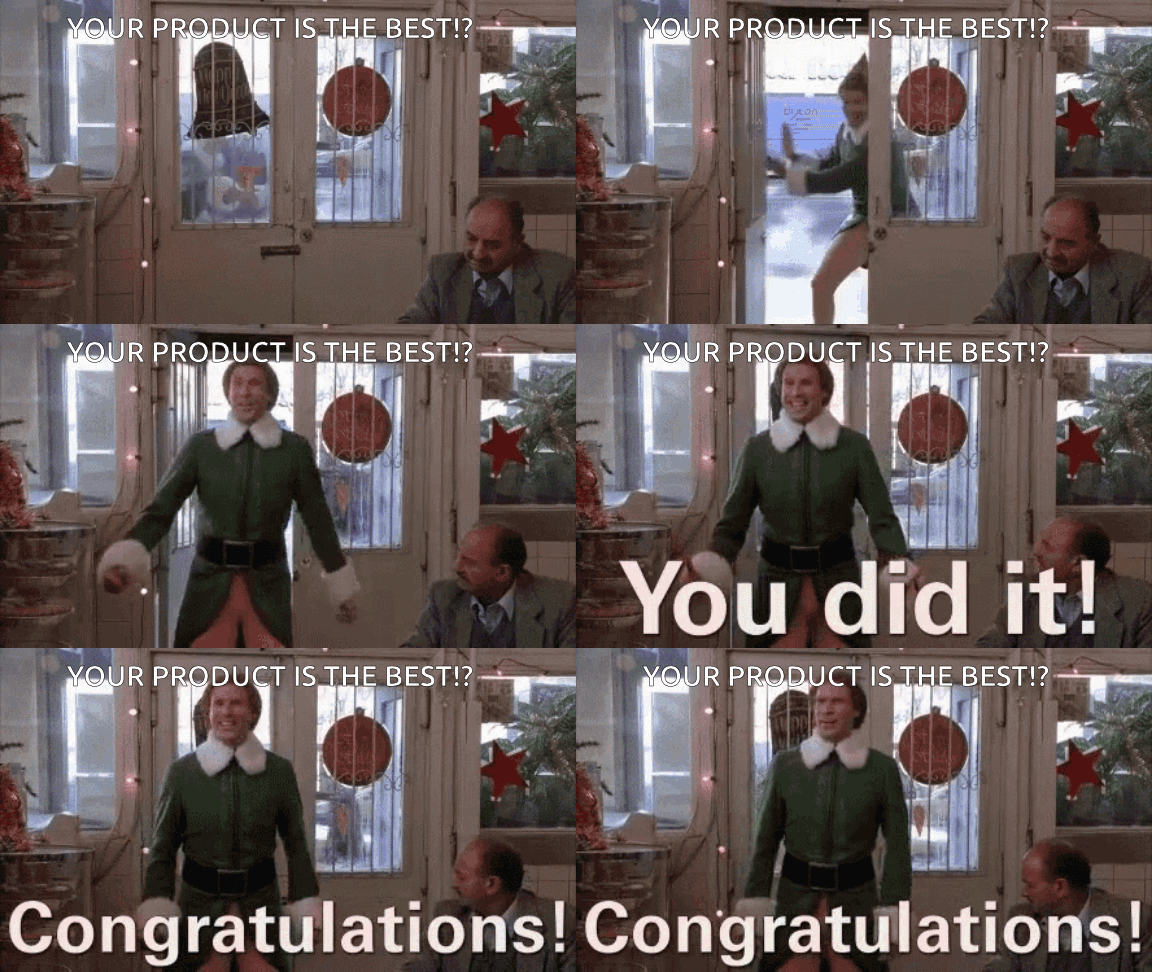
But… are you? Are you actually, objectively the best at what you do?
Because if you’re not actually the best… and you say you are… that’s… well, your pants are on fire.
But it’s also wasted deception: Because nobody cares. “We’re #1” does not get you the Buddy the Elf response. It usually gets you a “Oh, yeah? Prove it.” Or more likely, just an eye-roll, as they move on with their day.
In fact, I recently learned that these vague superiority claims aren’t subject to false advertising suits, because they’re what the law calls puffery. How wild is that? These superlatives are so common and so hollow, our legal system just assumes that people won’t believe them.
This is one of many reasons why you should spend the time to actually position your product.
In other words: Narrow the scope of what you’re the best at. If you continue to insist that you do everything for everyone, that means you actually need to be the best at everything for everyone. “The AI platform for getting things done”? Hope you’re better than Anthropic and OpenAI and Google!
This is part of the magic of the Playing To Win framework (shout out to Roger L. Martin!): If you want your business to win, where’s the best place to play? Choose a contest where you have an unfair advantage.
And of course, the alternative to narrowing your value prop scope is narrowing audience scope: Who’s the collection of potential customers where you can really, seriously, 100%-no-BS say: “We are objectively the best choice for you.”?
This is particularly true for small companies and new startups: You don’t want to play on the same field as the big, well-funded incumbent. If you’re going to define “best” according to their terms, they have decades of evidence and probably thousands of case studies of them doing what they do.
So unless you’ve developed a truly breakthrough technology that can already, visibly, immediately be seen as 10x better… choose a group of people that you can serve better than the big guys.
For ego reasons, it’s more fun to say “We are The Best. Period.” But it’s probably not true. So scope down your claim until it is: “We’re the best … for [this specific kind of person] and/or [this specific situation].”
True capabilities
The other area where I see companies get into trouble with this is overhyping what they can do.
This issue has caused PMs & engineers to wish physical harm upon their sales, marketing, and/or overenthusiastic founders since … forever. When you’re trying to close a deal or get adoption, or build public buzz, there’s a temptation to overpromise. “Sell the future.”
To be charitable, sometimes this is another unfortunate example of the fatal startup error of imitating big companies: When you have a locked-in roadmap and your client needs an 18-month sales cycle, it may make sense to describe where the product will be, rather than where it is right now. Or perhaps this is borrowing from manufacturing and hardware companies, where the product takes a long time to actually construct, and that process may not even start until after the purchase.
But a lot of times, it’s just FOMO: “Everyone else is saying they have this… if we don’t say we have it, we’ll get left behind!” This is how you get software product launches with an “Available next summer!!” type of delivery timeline.
Every “It’s coming soon” is a promise, and your current and potential customers will remember if you break it.
Of course it’s tempting to sell big now or promise everything on the front end. And market pressure will push you to go faster and to cut corners, but that’s the whole point: If you don’t tell the truth, the cost is lost trust.
Looking for trust in an artificial era
Trust is the foundation of civilization. It’s the basis for all business, and has been since, I don’t know, the first pelts were traded? But it’s even more important when things are fast and uncertain. And, uh, it seems like the entire business world right now feels very fast and very uncertain.
AI poses a risk to our fragile human brains’ ability to process things both because of (a) The raw volume of output, and (b) The convincingly realistic synthetic outputs.
Not only are we overwhelmed with the sheer amount of information being thrown at us in this post-information age, but we can’t tell whether a lot of it is real.
This kind of environment pushes us towards people and sources we already know, or have some reason to trust.
So it’s no surprise that Kyle Poyar & Maja Voje’s State of B2B GTM Report showed that networking/personal intros and small-scale events are the #1 and #2 go-to-market tactics for b2b companies right now.
And yeah, this is why the personality-driven distribution methods I mentioned are so effective. Build In Public, Founder-led content, Employee-generated content, and creator partnerships are all built on the same premise: An actual human is telling me this. Preferably someone I know, or at least someone who knows people I know. Or even someone with a credible body of online work that shows me they’re not just a bot account created last month.
But those mechanisms only work if they’re built on a culture of honesty that prioritizes truth-telling. A sturdy bridge to a crumbling destination won’t stand for long.
Honest benefits
If you need an extra reason to tell the truth, besides, well, y’know, ethical best practices and actual divine mandate, consider this:
The truth is faster to ship.
Most of us don’t even realize how much time and effort this could save. Think about each step of an initiative:
Decide: When you’ve made the hard choice to choose a position and committed to telling-it-like-it-is for your product capabilities, these choices don’t have to be re-litigated for every campaign or initiative. As Clayton Christensen put it: “It’s easier to hold to your principles 100% of the time than it is to hold to them 98% of the time.” (Note: I found that quote through Eric Ries and his conversation with Lenny, which covers a lot of these themes. And his newsletter is called Trust Is Everything! Check it out.)
Coordinate: CMOs (and CEOs, too) are used to the protection and consistency of multiple layers of approval and centralized control. With new AI updates changing the competitive field on a daily basis, you don’t have time for all of that. When you have a carefully-crafted-but-let’s-be-honest-not-actually-honest narrative, you need more of this—often through scheduled meetings and looping in lots of people. But if people are able to say what’s actually happening, you need much less oversight. Since we’re going with quotes, consider Mark Twain’s take: “If you tell the truth you don’t have to remember anything.”
Polish: This isn’t malicious necessarily, but the larger the gap between the thing itself and how you want it to be presented, the more it costs to bridge that gap. Marketing has always been associated with putting a glossy veneer on things, to make them seem appealing. But if you’ve been honest in your positioning and capabilities, it may not be necessary. If you find the right people, they won’t need that: A guy stranded in a desert doesn’t care whether the water you give him comes in brand-aligned packaging!
The truth is faster for learning.
Okay, one last thing: As I’ve said before, startups are science. The whole point is to learn as quickly as possible what’s working and what doesn’t. The whole goal is to identify the answer to the question I mentioned above: What are you the best at?
And that doesn’t work if you’re not telling the truth. If you promise you can do something when you can’t, you’ll get people who want that thing, instead of what you have.
If you’re “selling the future” to build hype, that means you’re talking about something that’s months away from being used. Which means you can’t get feedback on it, yet. Which means that you can’t learn as quickly and make it better.
The painful truth
If you’ve been reading this and thought, “Yeah, sounds good but our company won’t do that,” then you get it: This is painful. Scoping down your positioning and keeping sales pitches strictly accurate is no fun. All of the short-term incentives make it very tempting to take the easy route and just “fudge the truth” a bit.
But I want you to tell the truth, so I’ll tell it to you, too: There’s always a cost. If you pay the cost now, you can reap the reward of building trust with your audience—which seems like the only shot at continuing to grow our companies these days. Or you can take the easy path now and pay the cost later.
Either choice will compound, so go ahead and take the right step now: Be honest, go faster, learn faster, and when you’re the best, your whole marketing and comms engine won’t have to worry about what to say. You can just tell your ideal customer, “We’re the best choice for you.” And it will be true.
A waitlist for a feature that ships next summer is also a promise. But it shows who wants the feature before anyone builds it, so you learn early. That only stays honest if the page says the feature doesn't exist yet. Would you put that kind of waitlist on the safe side of your "coming soon" line?